DIAMOND EDUCATION
Diamond education is essential to understand the characteristics and quality aspects of diamonds. Through our Diamond education page, we aim to demystify these concepts and explain their influence on buying decisions, with the help of informative articles, guides and videos.
KNOW YOUR DIAMOND
- What Gives A Diamond Its Lustre?
- How Many Different Shapes & Sizes Are There?
- How Are Diamonds Graded And Certified?
- What Factors Influence Diamond Buying Behaviour?
Find The Answers To All Your Questions,
With The Diamond 5Cs Explained Below
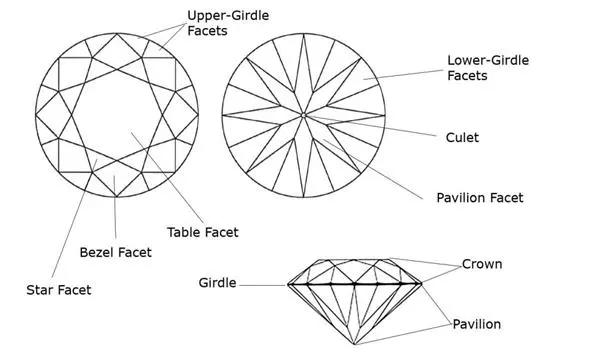
Anatomy of a Diamond
The design and craftsmanship of the diamond considers weight ratio (weight of the diamond relative to its diameter), the diamond's girdle thickness (which affects its durability), the symmetry of its facet arrangement, and the quality of polish on those facets. Cut is oftentimes confused with the shape of the diamond but cut refers to a stone’s facet arrangement. Shape refers to the outline of the stone. The most common diamond shape used in jewelry is round, as seen in the standard round brilliant cut. All other diamond shapes are known as fancy shapes. Traditional fancy shapes include the marquise, pear, oval and octagonal (as seen in the emerald cut). Square, cushion (square with rounded edges), triangle, and a variety of other shapes are also gaining popularity in diamond jewelry.
Understanding the 5Cs of Diamonds
CARAT
HIGHER THE CARAT, MORE THE WEIGHT OF THE DIAMOND. The special unit of measurement used to weigh diamonds is called 'carat'. Sometimes confused with the visual size of stones, carat refers to weight only. 1 carat is 0.2 grams or 1/142 of an ounce. When considering the five Cs that determine the value of diamonds, carat weight can be most accurately and easily calculated by using a delicately balanced scale capable of weighing extremely small stones. There is one significant fact about a diamond's weight and price. When diamonds are mined, large diamonds are discovered rarely in comparison to small ones, which makes large diamonds much more superior. For that reason, the price of a diamond rises exponentially with its size. So, a 2 carat diamond of a given quality is always worth much more than two 1 carat diamonds of the same quality. Simply put, the larger a diamond, the more valuable and rarer it is.
COLOR
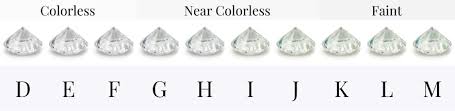
WITH REGARD TO DIAMONDS, COLORLESS ADDS MORE VALUE Though color is a defining factor, what actually matters is how 'colorless' a diamond is. The more colorless or white a diamond is, the more valuable it becomes. On moving down the scale, diamonds start to have slight tints of yellow in them which decrease their value. The Gemological Institute of America (GIA) grades diamonds from D (colorless) to Z (light yellow). The yellow tint in diamonds affects their dazzle and brilliance. A colorless stone lets greater amounts of light pass through it, making it sparkle and shine. The perception of a diamond's color differs across individuals. Most of us may not even notice the yellow in slightly tinted diamonds because the nuances of color are so slight. It is hence more important to look at the cut and shape when choosing a diamond, while Colorless and Near Colorless can be the ideal color choices. Diamonds tend to pull in color from their surroundings, especially the color of the ring or piece of jewellery on which they are mounted. This can sometimes render the “colorless” property of a diamond insignificant; a “near colorless” or “light tint” diamond pairs better with a yellow or rose gold mounting. The colorless stone here isn't the best investment, as it would anyway pull in the warmth of the yellow gold.
CLARITY
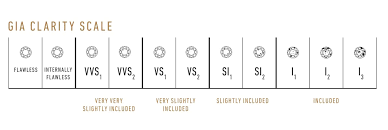
THERE’S CLEAR, THERE’S CRYSTAL CLEAR. THEN THERE ARE DIAMONDS. The term 'clarity' is used in reference to a diamond's purity, and is based on how many or how few inclusions there are in the stone as well as where these inclusions occur. Minuscule flaws can be trapped on or within a diamond when it is formed. Gemologists will examine these surface and internal flaws under 10x magnification when assigning a grading to each stone. Diamonds with little or no inclusions, graded FL (Flawless) and IF (Internally Flawless) are especially rare and valuable. The grades VVS1, VVS2 (Very Very Slight Inclusions), VS1, VS2 (Very Slight Inclusions) and SI1 (Slight Inclusions) are all worthwhile as they have inclusions not visible to the naked eye.
CUT
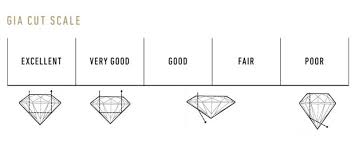
DIAMONDS THAT MAKE THE CUT, DAZZLE THE MOST. Cut has the biggest impact on the beauty of diamonds. The cut of a diamond does not just mean its shape, but also indicates the symmetry, polishing, angles and the proportions of each physical aspect of the diamond. A well-cut diamond reflects light perfectly to maximize the stone's brilliance. The light entering a diamond should reflect off all the facets and come straight back up, thus giving it a scintillating appearance. The depth of a diamond is of great importance; ideal depth is achieved when a diamond is cut neither too deep nor too shallow, as that causes light to be lost through the diamond instead of getting reflected back up. Diamond Cut Grade Chart Ideal cut : Ideal cut in a diamond implies ideal proportions and angles, wherein the diamond has the best polish and symmetry ratings. Excellent cut : Excellent cuts are considered top-grade cuts and will reflect almost all of the light that enters a diamond, creating unmatched brilliance and dispersion. Very good cut : Almost as good as Excellent cuts but with minimal loss of refracted light, these cuts provide amazing brilliance. Good cut : Good Cut diamonds reflect most of the light that passes through them, though not as much as Excellent or Very good cuts. These diamonds provide beauty at a lower price point. Fair cut : These offer little brilliance. Fair Cut diamonds may be a reasonable choice for smaller carats and those acting as side stones. Poor cut : Most of the light entering the diamond gets lost from the diamond’s sides/bottom, causing it to appear dark and lifeless.
COST
Potential diamond buyers might wonder what makes diamonds so expensive, how are costs decided, why two diamonds with the same grades are priced differently, etc. Buying their dream solitaire can be a once in a lifetime accomplishment for most people, so it is important to have the right answers to these questions. The costs of natural or mined diamonds are generally controlled by the miners as they extract and own the rough diamond resources. The emergence of lab-grown diamonds in the mid-twentieth century revolutionized the diamond industry in terms of cost. Lab-grown diamonds cost significantly less than their mined counterparts due to the elimination of monopolistic trade practices. Hence, lab-made diamonds are much more affordable with the same amount of beauty and durability as mined diamonds. Diamonds can be expensive, and justifiably so, as they are designed to stand the test of time. Fortunately, finding the perfect diamond that matches one's requirements and at the right price is absolutely possible! It just takes a little bit of effort, and the chances of finding a good deal online are many. Moreover, diamond experts are of immense help in solving queries and providing useful recommendations to assist buyers in getting the perfect diamond within their budget.